
Dinosaurs! Dinosaurs!
A conversation with renowned dinosaur paleontologist Barry James

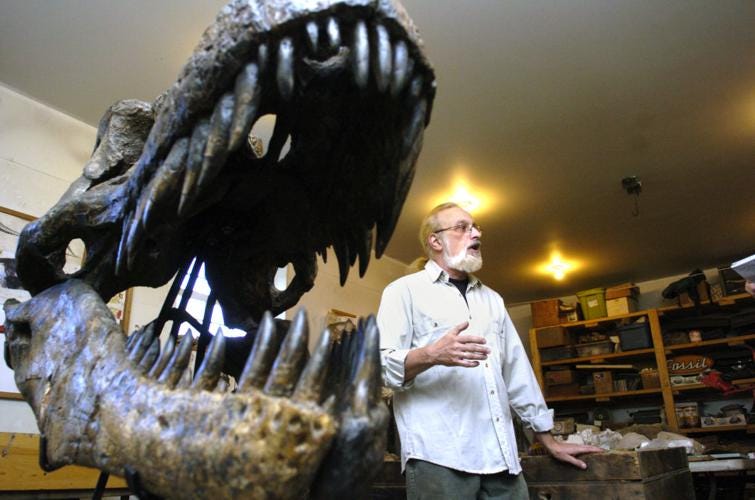
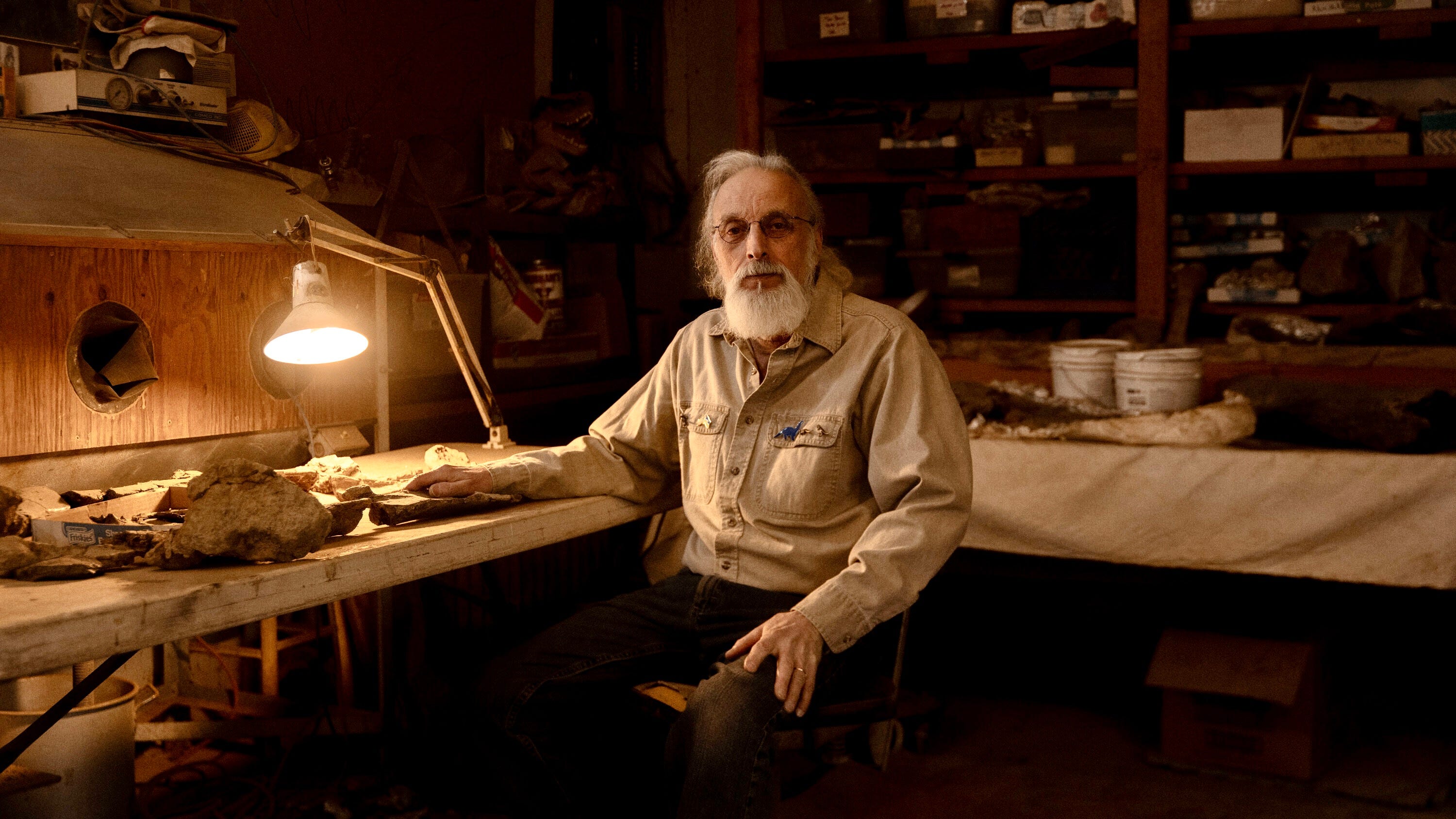
Barry James is a self taught commercial paleontologist, who reconstructs dinosaurs from bones sent to him from around the world and then sells the completed skeletons to museums and private collectors. He has built some 160 dinosaurs. He and his late wife April worked together and were considered leading experts in the preparation of dinosaur skeletons, combining his meticulous scientific approach with her artistic touch. On a warm day last month, I visited James at his workshop in a reconstructed dairy barn. Just inside the front door of the barn, I was greeted by the enormous, jet-black skull of a triceratops, more than nine feet in length, mounted on a metal post. The place looked like a mad scientist’s cluttered lab. In place of test tubes and coils of wire were tables of dozens if not hundreds of dinosaur bones, a table with newspaper articles and glowing letters of appreciation from universities and museums. On one wall hung pterodactyl bones and John Lennon quotes.
AL: When did you first get interested in fossils?
BJ: I was seven years old when I found my first fossil, a shell. When my father was digging a hole in the ground to plant a tree, I saw a small limestone rock. As I turned the rock, I saw a very small shell fossil.
AL: Not many kids that age would understand what a fossil is, or how old it might be. When did you first get interested in dinosaurs, in particular?
BJ: When I was eight years old, my parents took me to the New York Museum. I saw huge shell fossils and Dinos. Never could I think that years later, I and my crew would work on major Dinos for museums around the world.
AL: You are one of the world’s experts in reconstructing dinosaurs from their excavated bones. Why did you take up this profession?
BJ: To show all students, young and old, what can be accomplished when we all work together. Fossils must be found, then prepared and mounted, and [the reconstructed dinosaur] brought to museums for adults and children to see and maybe to touch.
AL: I see lots and lots of bones lying on tables. I gather these are all the different bones of the triceratops that you are now building. I am amazed that you can figure out where each of these bones goes in reconstructing the beast. I think that if young people could see your shop here, they would be even more interested in dinosaurs.
Why do you think that kids get excited by dinosaurs?
BJ: They know about Dinos since being babies. Clothes, hats, etc. have Dinos printed on them. As [people] get older, they realize that real Dinos exist. Just look at the Flintstones and all the other cartoons.
AL: True, real dinos exist, but they are long gone, and I think kids know this. That is why they can feel safe looking at these powerful and massive creatures. My amateur opinion is that if dinos were walking through the neighborhood today, most kids (and adults) would be extremely frightened. Also, I think the elaborate names of dinosaurs, like tyrannosaurus rex and triceratops and brachiosaurus, might add to the fascination with dinosaurs.
Do you think it is important to educate young people about dinosaurs? If so, why?
BJ: Yes. We all have to realize the past in order to understand the present. How the animals lived and protected their young. All of this is what mammals and humans are like. Only, we [humans] are more advanced and should help our young have a great life.
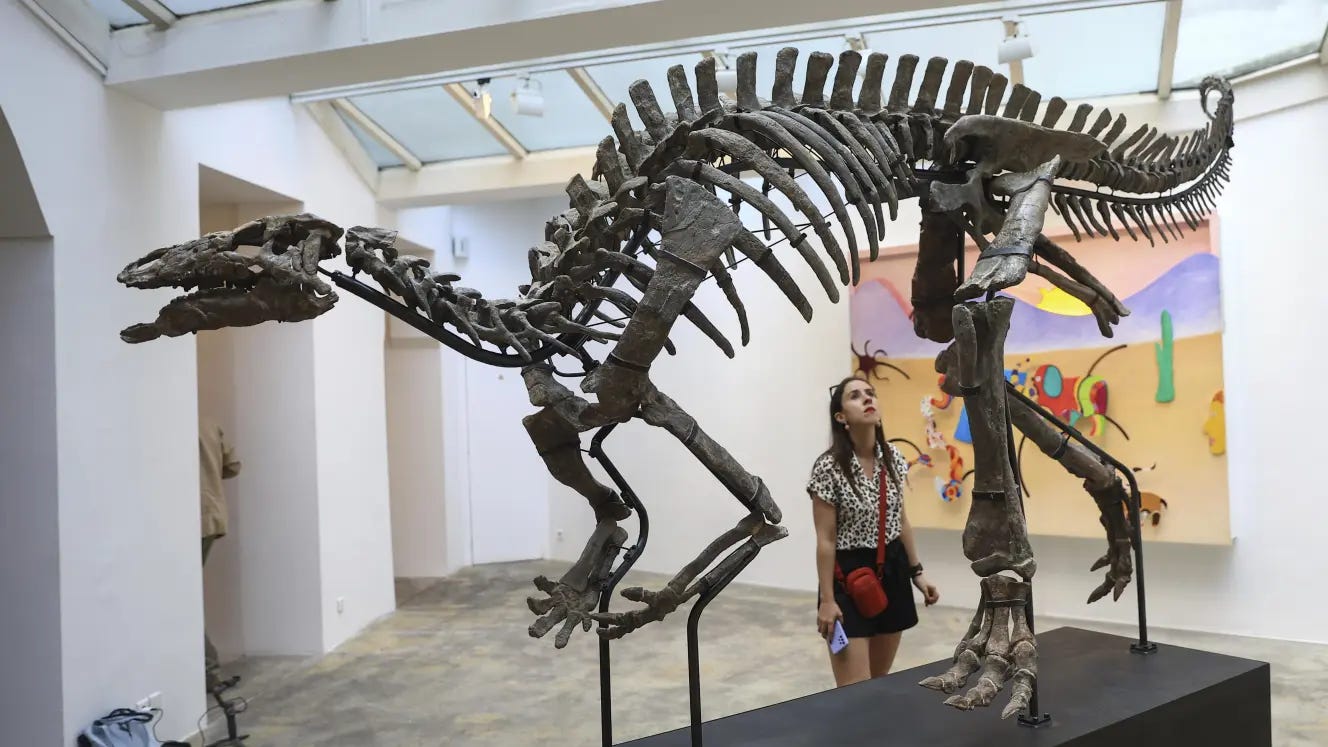
The above photo shows an unusually well-preserved dinosaur skeleton, a Camptosaurus known as Barry, sold on October 20, 2023 at an auction at the Hotel Drouot in Paris. The creature was restored in 2000 by Barry James, from whom it got its name. The bones of this older Barry, which dates from the late Jurassic period some 150 million years ago, was first discovered in Wyoming in the 1990s.
AL: Do you subscribe to the theory that the dinosaurs were killed off by a massive asteroid that slammed into the earth and kicked up a lot of dust?
BJ: Absolutely. There is plenty of evidence that a massive asteroid landed on what is now the Yucatan Peninsula in Mexico, which caused not just a cloud of dust, but a massive about of debris to fill the air as well as massive tidal waves.
AL: I understand that you wanted to create a dinosaur museum in Sunbury, your local community, but the idea was vetoed. Why did that happen?
BJ: Me and April, my wonderful wife, were willing to buy a building in Sunbury and donate many fossils and skeletons of prehistoric animals, but the mayor said ‘No, we don’t want you to teach our children about evolution.’
AL: What can dinosaurs teach us about the world and about ourselves?
BJ: We should all live in peace and help our children and all humans. Dinos help us understand the past, which will likely help us in the future. They and us are from planet Earth.